

Casement Window Replacement Cost: What Affects the Price?
Why Your Casement Window Quote May Be Higher
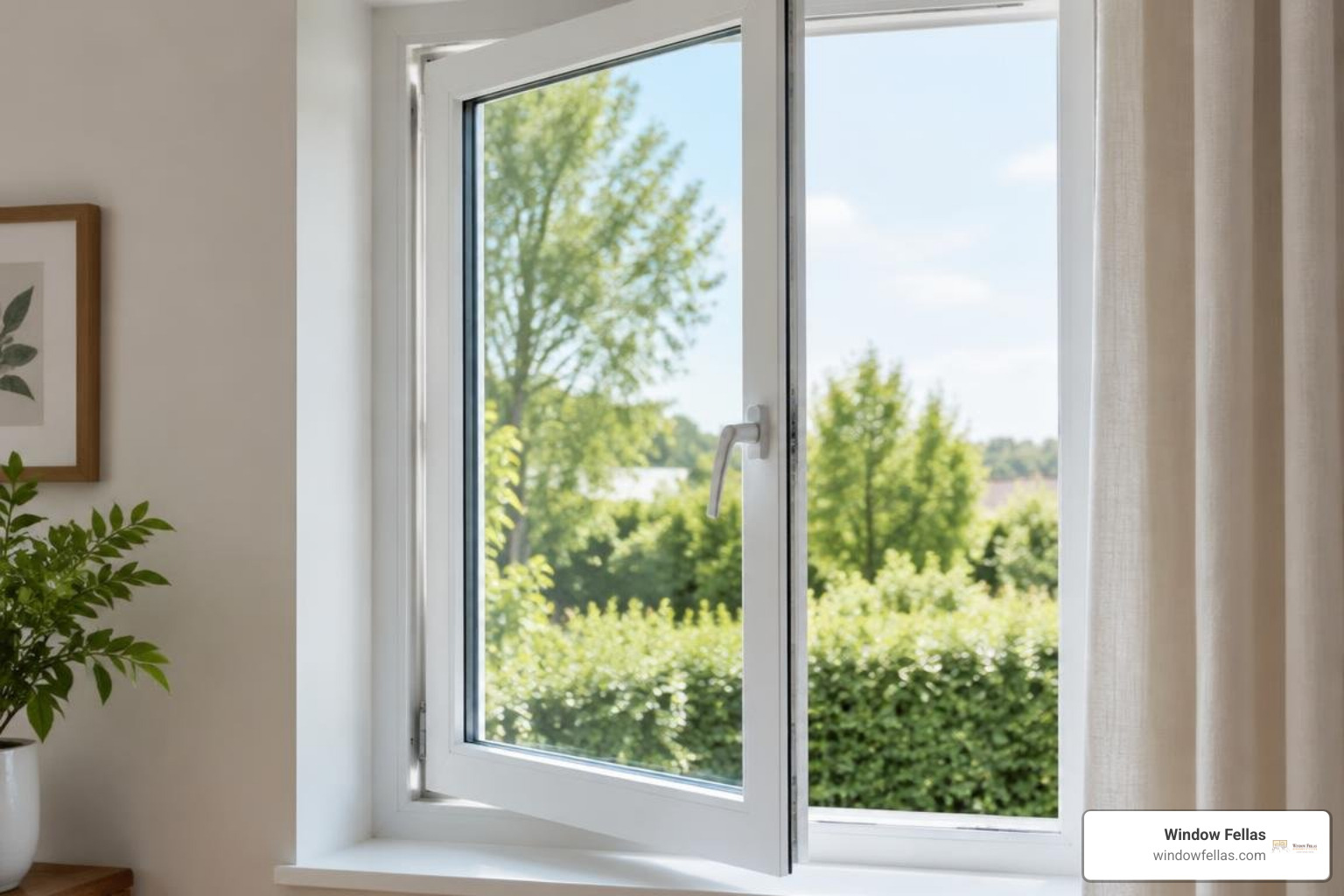
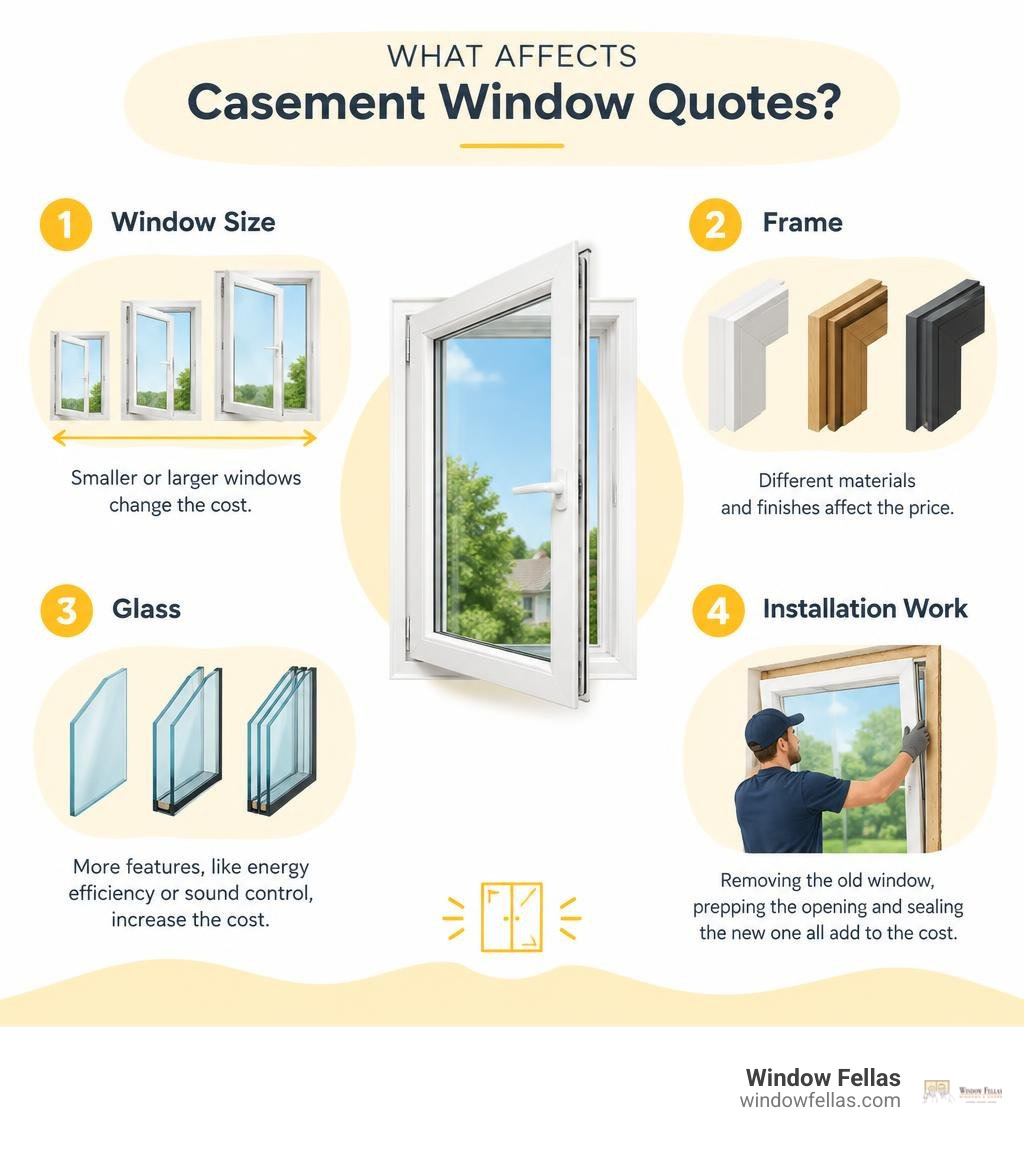
Your casement window replacement cost can differ from your neighbor’s because the window size, frame, glass, and condition of the opening may differ. To compare quotes fairly, match the window specifications and check what each price includes, from removing the old window to fitting and sealing the new one.
A lower total may cover less work. Ask for an itemized quote so you can compare the same window replacement options and installation scope.
This guide breaks down casement window replacement cost and the details behind a quote so options can be compared with confidence.
Casement window replacement cost: national benchmarks
Published estimates give you a starting point, not a price. One widely cited third-party guide puts the US national average at about $815 per casement window, with most homeowners spending between $260 and $950. Another survey-based guide lists a broader range of $400 to $2,400 per window. These are third-party US national averages for orientation only. They are not a Window Fellas quote and not a local price.
Why do the numbers vary so much? Each source defines the job differently. Some figures cover the window unit alone. Others bundle in labor, removal, and finishing. Product quality, the sample of homeowners surveyed, and the year of the data all shift the result. A “material-only” number and a “full project” number are not the same thing, so never compare them directly.
Scope matters just as much. Replacing a window can mean fitting a new unit inside the existing frame or replacing the whole frame, trim and all. The second option involves more work and a higher total. For window replacement, the approach depends on whether the existing frame is square, solid, and dry.
For a broader look at how replacement pricing works across window styles, NerdWallet’s replacement window cost guide is a useful independent read. It also covers return on investment and energy savings.
How size and configuration change casement window replacement cost
Size is the most intuitive cost driver. Third-party data shows a small 24-by-36-inch casement unit running roughly $260 to $360, while a large 36-by-60-inch unit can run roughly $335 to $630. These are third-party US national averages for orientation only. They are not a Window Fellas quote and not a local price.
Standard sizes keep costs down because manufacturers build them in volume. Custom sizing means made-to-order glass and sashes, which adds cost and can extend the process. Large casements also carry more glass weight, which puts more demand on hinges and makes handling harder.
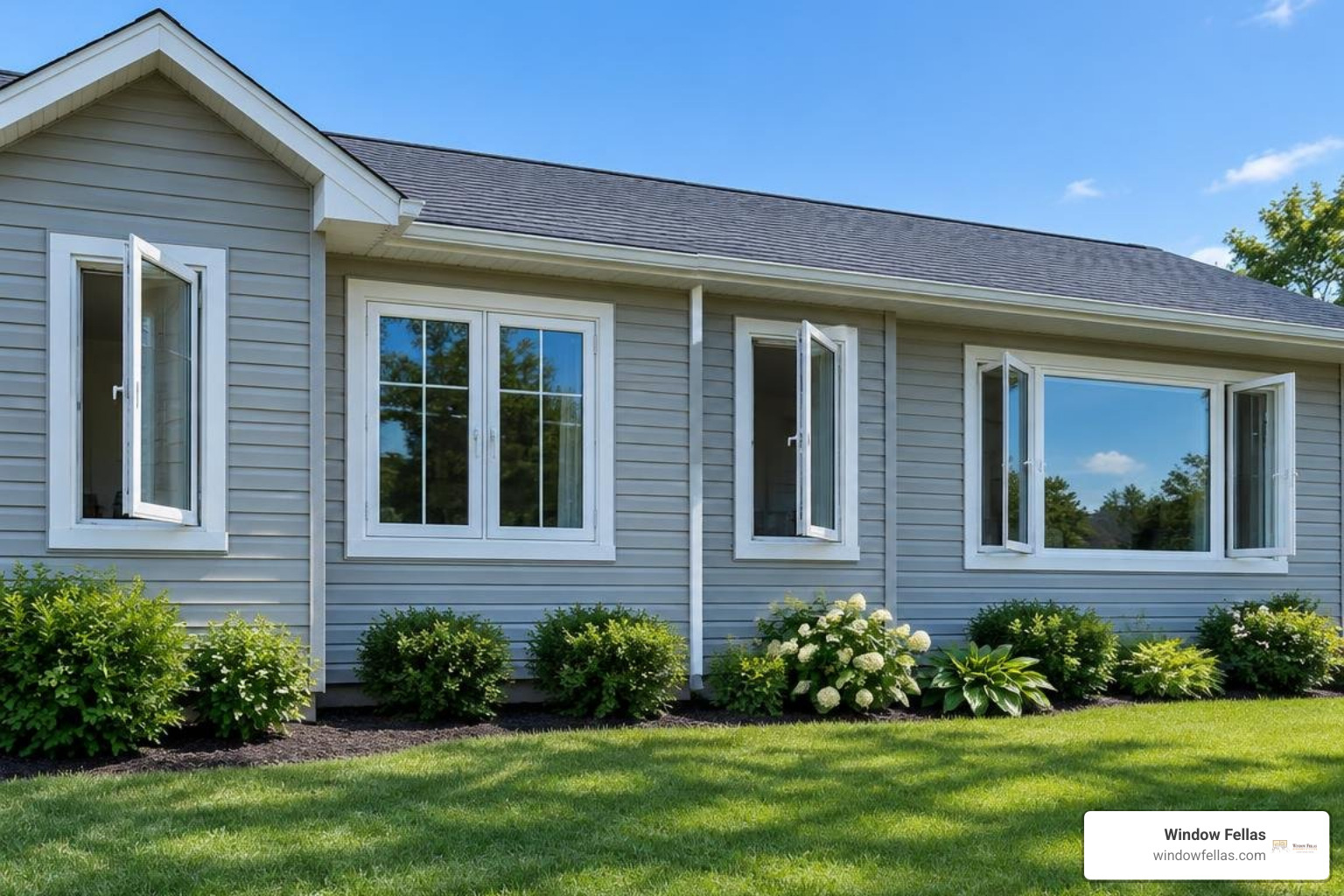
Configuration changes the price too. A single casement is the simplest. A double (French) casement uses two sashes meeting in the middle, so you are paying for more glass, more hardware, and more installation time. Push-out and top-hinged styles use different hardware, and cottage-style layouts split the glass differently. A fixed picture window with casement flankers on each side adds ventilation to a view window. An egress casement is built to meet code for emergency exit, so size and opening requirements matter.
| Size or configuration | Relative cost | Project complexity |
|---|---|---|
| Small standard single casement | Lower | Simple, easy handling |
| Medium standard single casement | Moderate | Straightforward |
| Large single casement | Higher | Heavier glass, more careful handling |
| Double (French) casement | Higher | Two sashes, more hardware |
| Push-out or top-hinged | Moderate to higher | Specialty hardware |
| Cottage-style | Moderate to higher | Split glass layout |
| Picture window with flankers | Higher | Multiple units, careful alignment |
| Egress casement | Highest of the group | Code-driven size, possible framing changes |
| Custom size | Varies, often higher | Made to order |
Egress units are a good example of how a code requirement can raise a quote. Bedrooms and basements often need an opening large enough to exit through, so a window that looks similar to a standard one may be sized and built differently.
How frame and glass choices affect casement window replacement cost
Frame material is one of the biggest line items. Here is how the common choices compare:
- Vinyl: usually the most budget-friendly and low-maintenance. See our vinyl window replacements for details.
- Wood: a classic look and good natural insulation, but it needs regular painting or sealing. Our wood window replacements page explains the tradeoffs.
- Aluminum: strong and slim, but it conducts heat more readily than other frames.
- Fiberglass: stable, durable, and energy-efficient, usually at a higher price than vinyl. Learn more about fiberglass frames.
- Composite: wood fibers blended with polymers, offering durability with less upkeep.
One third-party guide lists frame-only ranges of about $200 to $780 for vinyl, $260 to $2,000 for wood, $200 to $1,180 for aluminum, $535 to $1,575 for fiberglass, and $350 to $1,450 for composite. These are third-party US national averages for orientation only. They are not a Window Fellas quote and not a local price.
Glass packages add another layer. Single-pane glass is cheapest but insulates poorly. Double-pane is the common middle ground, and triple-pane adds insulation at higher cost and weight. One guide lists about $150 to $600 for double-pane and $400 to $950 for triple-pane units. These are also third-party US national averages for orientation only. They are not a Window Fellas quote and not a local price.
Coatings and gas fills can raise the price further. Low-E coatings reduce heat transfer, and argon or krypton between the panes improves insulation. The US Department of Energy has estimated that low-E coatings can cut energy loss significantly.
| Choice | Relative cost | Upkeep | Insulation |
|---|---|---|---|
| Vinyl | Lower | Low | Good |
| Aluminum | Lower to moderate | Low, can corrode over time | Weaker |
| Composite | Moderate to higher | Low | Very good |
| Fiberglass | Higher | Low, occasional repainting | Very good |
| Wood | Moderate to highest | Highest, regular refinishing | Very good |
| Single-pane glass | Lowest | Low | Weakest |
| Double-pane glass | Moderate | Low | Good |
| Triple-pane glass | Highest | Low | Best |
| Low-E and gas fills | Added cost | None | Improved |
Brand, labor, and project scope
Brand tiers matter, but not in the way people expect. Most manufacturers offer several product lines, from entry-level to premium. The difference between lines shows up in frame construction, glass options, hardware quality, hinge and crank design, and finish choices. Two quotes from “the same brand” can describe very different windows.
Because of that, a brand comparison only means something when the frame, glass, hardware, and included work all match. Ask each contractor for the exact product line, glass package, and hardware type in writing.
Labor is the next piece. Third-party guides estimate professional installation at roughly $100 to $300 per window, with old-window removal and disposal adding about $60 more per window. These are third-party US national averages for orientation only. They are not a Window Fellas quote and not a local price.
Installing several windows at once often makes sense. Setup, access, and cleanup are shared, so bundled work can be more efficient than a string of single-window visits. Whatever the quote says, it should spell out what is included.
Why casement window quotes differ
Two houses on the same street can have very different openings behind the trim. The biggest quote differences usually come from what is found once the old window is out.
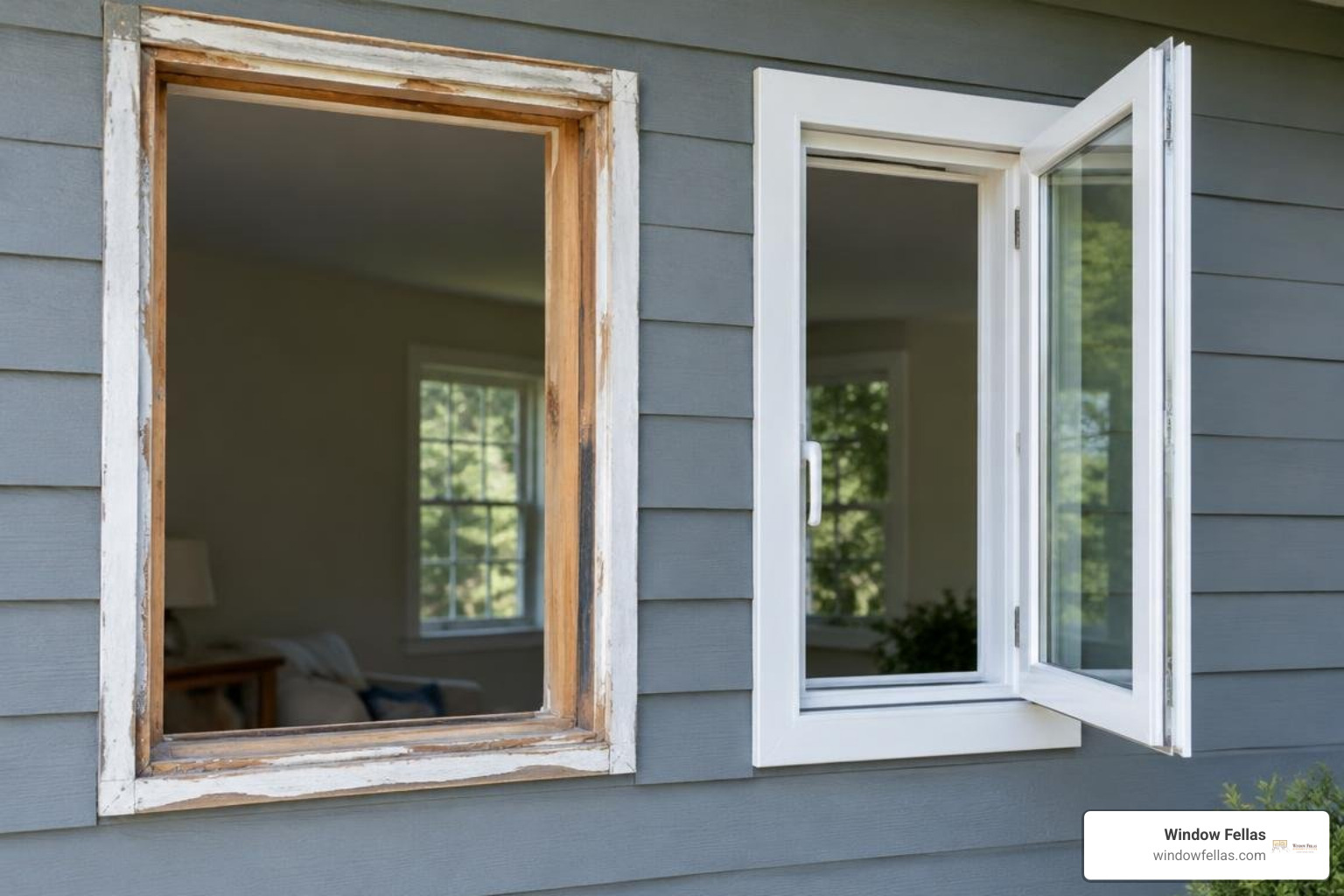
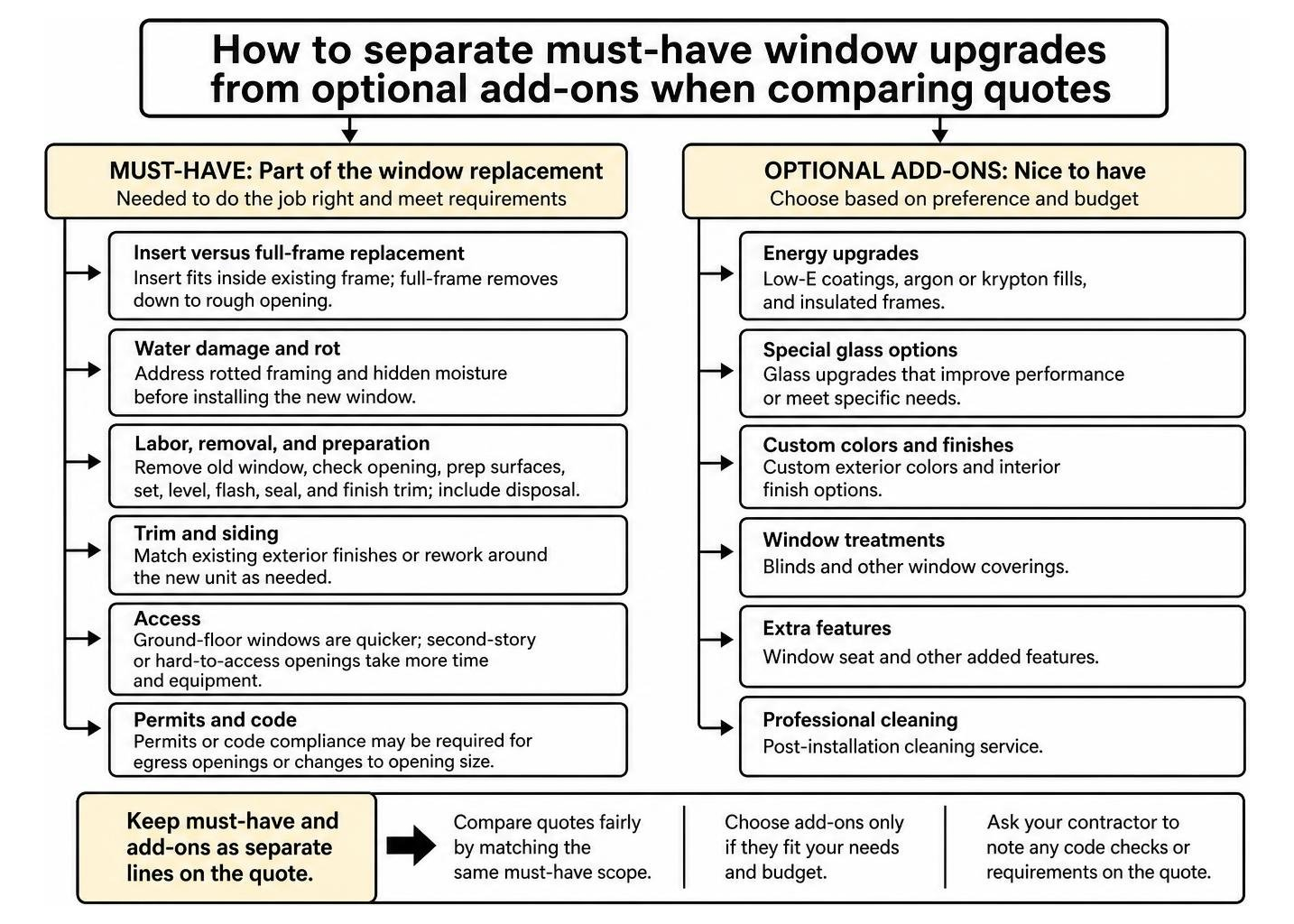
Insert versus full-frame replacement. An insert replacement fits a new window inside the existing frame, which works when the frame is square, solid, and dry. A full-frame replacement removes everything down to the rough opening. It costs more, but it lets hidden problems be addressed.
Water damage and rot. Moisture can hide behind trim and siding. Rotted framing has to be addressed before a new window goes in, and that is additional work beyond the window itself.
Trim and siding. Matching existing exterior finishes, or reworking them around a new unit, changes the labor involved.
Access. A ground-floor window is quicker to reach than a second-story or hard-to-access opening. Difficult openings take more time and sometimes more equipment.
Permits and code. Some projects, especially those involving egress openings or changes to the opening size, may require permits or code compliance. Check with your local building department about what applies to your home.
Upgrades and finishes. Energy upgrades, custom colors, and special glass options all affect price. Your neighbor may simply have chosen a different package.
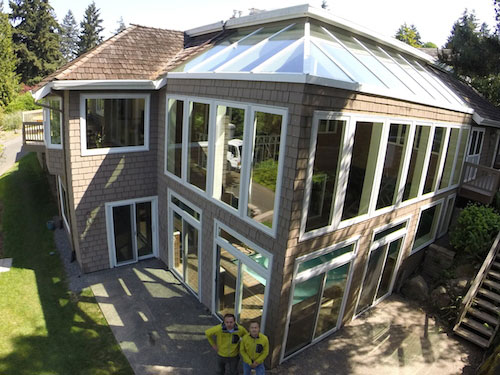
Seeing finished work helps you picture the scope. Browse our window project examples to see what different installations look like.
Labor, removal, and preparation
Professional installation covers more than setting a unit in a hole. A proper job includes removing the old window, checking the opening, preparing the surfaces, setting and leveling the new window, flashing and sealing it, and finishing the interior and exterior trim. Disposal and cleanup should be part of the scope as well.
Preparation work is where quotes diverge most. Enlarging a window opening is a structural change that may need new framing, and cutting a brand-new opening involves even more. Third-party guides put opening enlargement at roughly $800 to $5,000 and a new opening at roughly $1,000 to $5,000 on top of the window. These are third-party US national averages for orientation only. They are not a Window Fellas quote and not a local price.
Other conflicts can surface too, such as electrical wiring or plumbing near the opening. Those items usually fall outside a basic window quote, so ask how a contractor handles them. An itemized estimate should list removal, preparation, trim work, and any structural changes as separate lines.
Energy upgrades and add-ons
Not every upgrade pays off equally, so separate the useful from the optional. Low-E coatings, argon or krypton fills, and insulated frames improve performance, and they can matter more in homes with large or sun-exposed windows. One third-party guide lists energy-efficient casement upgrades at roughly $120 to $1,200, with Low-E coatings around $250 to $840 and argon fill around $380 to $850. These are third-party US national averages for orientation only. They are not a Window Fellas quote and not a local price.
Optional add-ons include window treatments, blinds, a window seat, and professional cleaning. They are worth budgeting for if you want them, but they are not part of the window replacement itself. Keep them as separate lines so they do not blur your comparison.
Also ask about code checks. Tempered glass may be required near doors or in bathrooms, and egress rules apply in sleeping areas and basements. A good quote notes these requirements instead of leaving you to discover them later.
Budget beyond the window: ongoing ownership costs
A casement window has more moving parts than a fixed window, so plan for modest upkeep. A simple routine goes a long way:
- Clean the glass and frame regularly, and wash the glass at least twice a year.
- Inspect seals and weatherstripping once a year and replace worn sections.
- Lubricate the crank mechanism about once a year with a silicone-based product.
- Check hinges and locks for rust, looseness, or wear.
- For wood frames, refinish or reseal about every five years to protect against moisture.
Third-party guides estimate professional cleaning at roughly $150 to $300 per visit, hardware replacement such as cranks and hinges at about $75 to $200, and seal work at about $200 to $600. These are third-party US national averages for orientation only. They are not a Window Fellas quote and not a local price.
Sometimes continued upkeep stops making sense. If a window has fogged glass, failed seals, warped frames, or repeated hardware trouble, replacing the unit is often the better long-term choice. If the problem is limited to a worn crank or weatherstripping, a smaller fix may be enough.
Compare quotes, weigh DIY, and plan your budget
The cleanest way to compare quotes is to gather three itemized estimates for the same size windows. Then check each one against this list:
- Matching frame material and glass package
- The same hardware and product line
- Labor scope, including removal and disposal
- Permits, if your project needs them
- Cleanup
- Product coverage and workmanship terms, in writing
- A process for written change orders if the scope shifts
A quote that looks cheap may leave out trim, disposal, or sealing details. A higher quote may include them.
To manage your budget, choose standard sizes and colors, since custom options add cost. Shopping in the off-season, usually late fall and winter, may open up better scheduling or promotions. Replacing several windows together can reduce per-window labor, and if the budget is tight, you can stage the project and start with the windows in the worst shape. For larger projects, ask about financing options.
If you are considering DIY, one third-party guide lists DIY materials at roughly $200 to $2,000, plus tools such as a drill and saw. These are third-party US national averages for orientation only. They are not a Window Fellas quote and not a local price. Labor savings are real on paper, but mistakes can cost more than they save, so factor in the risk of water intrusion and air leakage.
When DIY may make sense, and when to hire an installer
DIY can work if you have installation experience, a ground-floor window, a standard opening in good condition, and a helper for safe lifting. You will need to measure precisely, set the window plumb and square, flash it correctly, apply sealant properly, and let water drain away from the sill instead of trapping it.
Hire an installer when the framing is complex, the window is on an upper floor, the opening needs to change size, or you are dealing with an egress requirement. Check manufacturer terms first before deciding. DIY savings cannot be promised, since results depend on skill and the condition of the opening. If an installer’s assessment of the opening is wanted before deciding, a professional inspection can identify framing, access, and code issues.
Frequently asked questions about casement windows
Are casement windows the most expensive window style?
No. Casements generally cost more than basic single-hung or double-hung windows because of their hardware and sealing system, but bay and bow windows typically cost more. Those involve multiple units, custom framing, and often structural support.
Are casement windows safer than double-hung windows?
In terms of security, casements are hard to pry open from outside because the sash presses into the frame and locks at multiple points. Worn or rusty hinges and locks can weaken that advantage, so keep hardware in good shape. For child safety, double-hung windows let you open only the top sash, while casements swing fully open. Consider limiting how far the sash opens if young children are in the home.
Can wind damage an open casement window?
Yes. Because the sash swings outward, a strong gust can slam it against the house, stress the hinges, or even pull the sash off. Close and latch casements during high winds.
Conclusion
The gap between your quote and your neighbor’s usually comes down to specifics: window size, frame material, glass package, hardware, and the condition of the opening. Compare quotes only when the specifications match and the project scope is realistic, including removal, preparation, and finishing.
Comparing replacement options based on size, frame, glass, hardware, and opening condition helps clarify why quotes differ. When ready to compare, a request a replacement quote provides a written scope for the openings.